
Balls
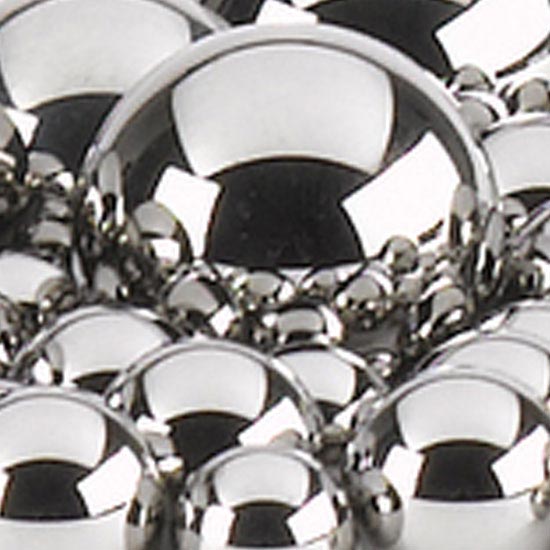
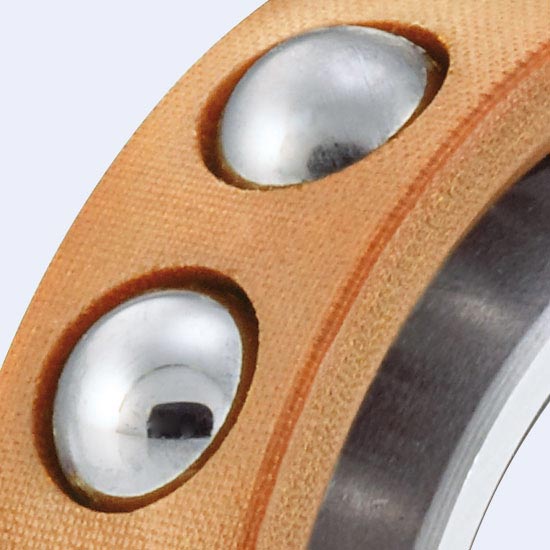
STANDARDWERKSTOFF
- Material
Rolling bearing steel (chromium steel) 100Cr6, material no. 1.3505, SAE 52100, SUJ2
Special steels available upon request
- Permissible operating temperature
Heat-stabilized up to a continuous operating temperature of 150°C (briefly up to 180°C)
- Hardness
60 to 64 HRC, through-hardened; corresponds to 700–800 HV30 Properties
High purity and homogeneity, vacuum degassed
SPECIAL MATERIAL (HYBRID BALL BEARING)
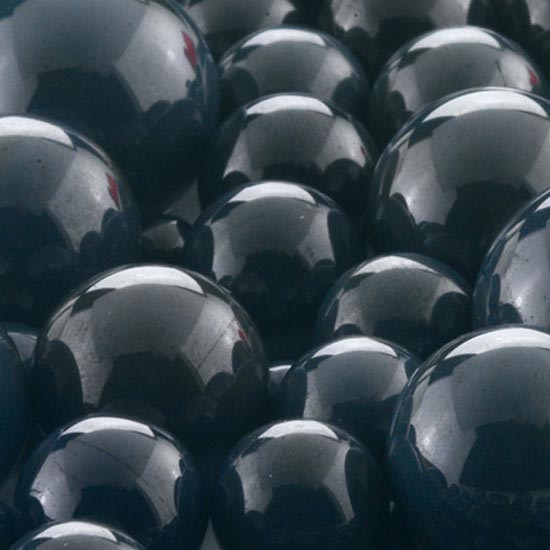
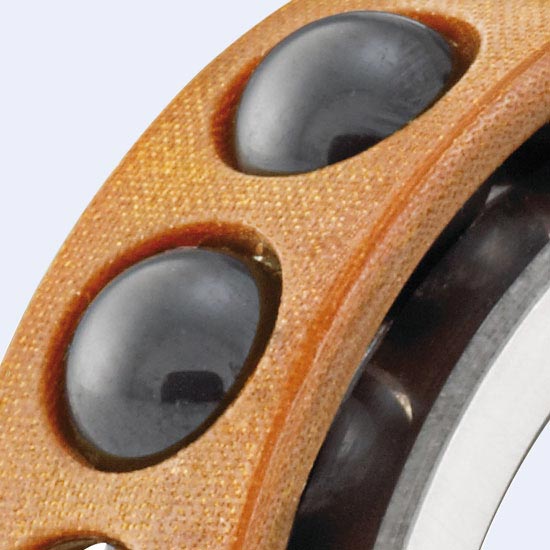
Hybrid ball bearings are characterized by a combination of rolling-element steel (inner and outer rings) and ceramic (balls). The material properties of ceramic balls result in significant performance improvements in machine operation—particularly under critical conditions—compared to ball bearings with steel balls.
- Material
Ceramic (silicon nitride, Si3N4)
- Material Properties
Low affinity for 100Cr6
Low coefficient of friction
Low thermal conductivity
Corrosion resistance
Non-magnetic
Electrically insulating
Longer service life
Due to their unique material properties, hybrid bearings last more than twice as long as steel bearings. Machine uptime is significantly increased.
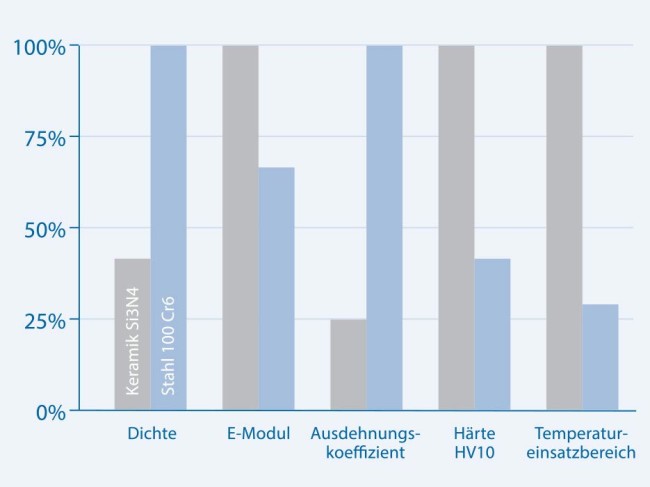
Comparison of Material Properties
Higher Rotational Speeds
Thanks to their tribological properties and lower inertial forces, rotational speeds can be increased by up to 30% compared to bearings with steel balls.
Lower-cost lubrication
The maximum speed for grease and oil lubrication is increased. As a result, grease lubrication can often be used instead of more expensive oil lubrication.
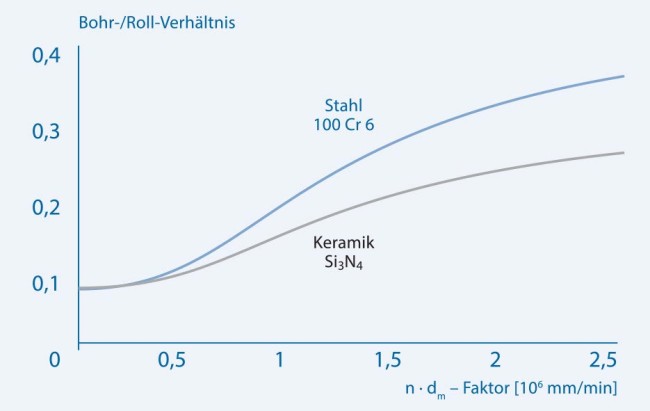
Milling/rolling ratio
Higher Machining Accuracy
Greater bearing stiffness, reduced thermal expansion, and lower vibration excitation enable maximum machining accuracy.
Higher Stiffness
Their material properties improve radial and axial stiffness. The benefits include increased accuracy and a shift in critical natural frequencies.
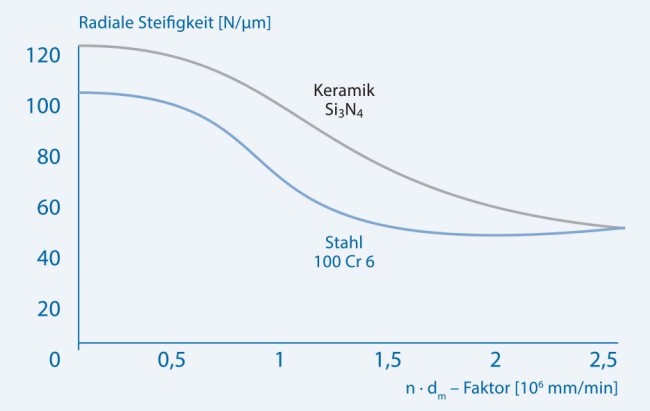
Radial stiffness
Examples of use
- Machine tool spindles
- High-speed machine bearings
- Precision bearings optimized for service life
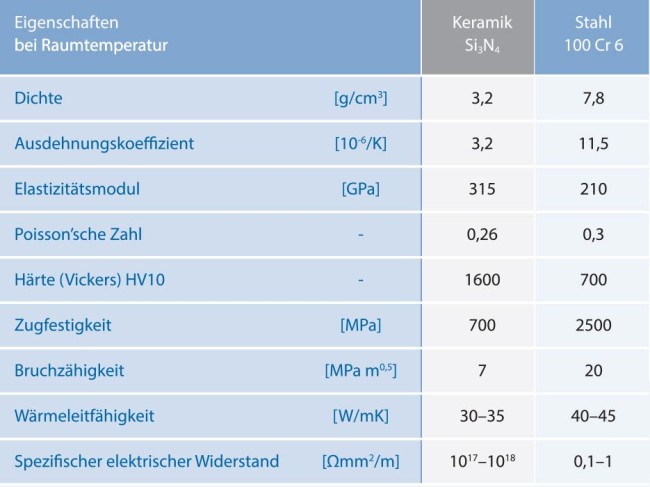
Properties of Ceramic (Silicon Nitride) Si3N4 and Bearing Steel (Chromium Steel) 100Cr6